Saturday, January 27, 2024

DeepEnd Research: Analysis Of Trump's Secret Server Story


 We posted our take on the Trump's server story. If you have any feedback or corrections, send me an email (see my blog profile on Contagio or DeepEnd Research)

Analysis of Trump's secret server story...


More information
  1. Hacker Tools Online
  2. Hacking Tools For Windows 7
  3. Hacker Tool Kit
  4. Hacker Tools Free Download
  5. Pentest Tools Github
  6. Hacker Hardware Tools
  7. Hacker Tools Linux
  8. What Is Hacking Tools
  9. Hacker Tool Kit
  10. Pentest Tools Nmap
  11. Pentest Tools Nmap
  12. Hacking Tools And Software
  13. Hack And Tools
  14. Pentest Tools Github
  15. Hack Tools For Mac
  16. Hacking Tools Usb
  17. Pentest Tools Github
  18. Black Hat Hacker Tools
  19. Pentest Tools Linux
  20. Hacking Tools 2019
  21. Hack Tool Apk No Root
  22. Pentest Tools Website
  23. Pentest Tools For Windows
  24. Pentest Tools Android
  25. Hack Tool Apk No Root
  26. Pentest Tools Review
  27. Hacker Tools For Ios
  28. Hack Tools Mac
  29. Hacking Tools Online
  30. Android Hack Tools Github
  31. Hack Tools Github
  32. Pentest Tools Windows
  33. Hacking App
  34. Growth Hacker Tools
  35. Tools Used For Hacking
  36. Hacker Tools Windows
  37. What Is Hacking Tools
  38. Nsa Hack Tools
  39. How To Hack
  40. Hacker Tools For Pc
  41. Hacker Tools
  42. Hacker Tools Free Download
  43. Pentest Tools Online
  44. Growth Hacker Tools
  45. Pentest Tools Open Source
  46. New Hacker Tools
  47. What Is Hacking Tools
  48. Hacker Tools Software
  49. Black Hat Hacker Tools
  50. Hacker
  51. Pentest Tools Tcp Port Scanner
  52. Pentest Tools For Windows
  53. Hacker Search Tools
  54. Hacking Tools Kit
  55. Hack Tools Online
  56. Pentest Tools Linux
  57. Hacking Tools 2019
  58. Hacking Tools For Pc
  59. Best Hacking Tools 2020
  60. Hacking Tools For Windows Free Download
  61. Pentest Tools Free
  62. Pentest Tools Download
  63. Hacking Tools Github
  64. Pentest Tools For Windows
  65. Hacker Tools For Mac
  66. Hacker Tools Hardware
  67. Hacker Security Tools
  68. Hacking Tools Kit
  69. Hacker Tools 2019
  70. Hacking Tools Pc
  71. Github Hacking Tools
  72. Hacking Tools For Windows Free Download
  73. Hacking Tools And Software
  74. Hacker Tools 2019
  75. Hacking Tools Name
  76. Hacker Hardware Tools
  77. Hacker Search Tools
  78. Termux Hacking Tools 2019
  79. Hacker Tools Windows
  80. Tools For Hacker
  81. Hacker Tools For Windows
  82. Hack Apps
  83. Game Hacking
  84. Hacker Tools Online
  85. Hack Tools Mac
  86. Hacker Techniques Tools And Incident Handling
  87. Hacker Tools Online
  88. Nsa Hacker Tools
  89. Hacker Tools Software
  90. Pentest Tools Tcp Port Scanner
  91. Hack Tool Apk
  92. Hacker Tools Hardware
  93. Pentest Tools Nmap
  94. Ethical Hacker Tools
  95. Pentest Tools Review
  96. Pentest Tools For Android
  97. Hacker Tools Windows
  98. Hacker Tools Windows
  99. Hacking Tools Hardware
  100. How To Make Hacking Tools
  101. Hack And Tools
  102. Termux Hacking Tools 2019
  103. Hacking Tools Name
  104. New Hack Tools
  105. Hacker Search Tools
  106. Tools Used For Hacking
  107. Pentest Tools Free
  108. Pentest Tools Windows
  109. Physical Pentest Tools
  110. Pentest Tools Tcp Port Scanner
  111. Hacking Apps
  112. Pentest Tools Framework
  113. Hacker Tool Kit
  114. Pentest Tools Website
  115. Hack Tools For Mac
  116. Pentest Tools For Mac
  117. Hacking Tools Download
  118. Hacking Tools Online
  119. Pentest Tools For Mac
  120. Pentest Automation Tools
  121. Hacking Tools And Software
  122. Hackers Toolbox
  123. Pentest Tools For Android
  124. Growth Hacker Tools
  125. Pentest Tools For Windows
  126. Hacking Tools Kit
  127. Hacker Techniques Tools And Incident Handling
  128. Hacking Tools Mac
  129. Pentest Reporting Tools
  130. Hacks And Tools
  131. Hacking Tools Name
  132. Hacker Tools 2020
  133. Hacking Tools Free Download
  134. Hack Tools Pc
  135. Hacker Tool Kit
  136. Pentest Tools Online
  137. Hacking Tools For Windows 7
  138. Nsa Hacker Tools
  139. How To Make Hacking Tools
  140. Hacker Tools For Windows
  141. Hacking Tools For Mac
  142. Hacking Tools
  143. Hacking Tools Hardware
  144. Hacking Tools For Windows
  145. Hacking Tools For Mac
  146. Pentest Tools Tcp Port Scanner
  147. Pentest Tools Bluekeep
  148. Pentest Tools Online
  149. Hacking Tools For Games
  150. Hacking App
  151. Hack Tools For Mac
  152. Hack Tools For Mac
  153. Easy Hack Tools
  154. How To Install Pentest Tools In Ubuntu
  155. Pentest Tools Tcp Port Scanner
  156. Pentest Tools Subdomain
  157. Hacker Tools For Mac
  158. Pentest Tools Review
  159. Pentest Box Tools Download

Hackerhubb.blogspot.com

Hackerhubb.blogspot.com

Related posts


Friday, January 26, 2024

5 Free Online Courses To Learn Artificial Intelligence

We are living in the era of fourth industrial revolution(4IR), where Artificial intelligence has a significant role to play. This 4IR technology embedded within societies and even into the human body. From Computer enthusiasts to common people, everyone should be aware and learn this breakthrough technology.
We think about gigantic Robots from Transformers when we hear about Artificial Intelligence(AI) which is a fiction in the past but a fact today, capable of transforming the whole tech world. The field of AI consists of more than Robots such as personal assistants, self-driving cars, apprenticeship learning, behavior cloning and so on. To learn about this advanced technology, thanks to the online learning resources which offers great content to get started with artificial intelligence.

Here are the 5 free e-learning courses on Artificial Intelligence

1. UC Berkeley CS188 Intro to AI

Get started with UC Berkeley AI course, this course is absolutely for beginners who are unaware of Artificial intelligence. It doesn't need any prior computer knowledge to know about AI. UC Berkeley allows anyone to learn this course for free. This course is systematically presented and consists of the following:
  • Course Schedule
  • Complete sets of Lecture Slides and Videos
  • Interface for Electronic Homework Assignments
  • Section Handouts
  • Specs for the Pacman Projects
  • Source files and PDFs of past Berkeley CS188 exams
  • Form to apply for edX hosted autograders for homework and projects (and more)
  • Contact information
Aside from this, you can also browse the following courses as well from UC Berkeley that are part of AI course:
  • Machine Learning: CS189, Stat154
  • Intro to Data Science: CS194-16
  • Probability: EE126, Stat134
  • Optimization: EE127
  • Cognitive Modeling: CogSci131
  • Machine Learning Theory: CS281A, CS281B
  • Vision: CS280
  • Robotics: CS287
  • Natural Language Processing: CS288

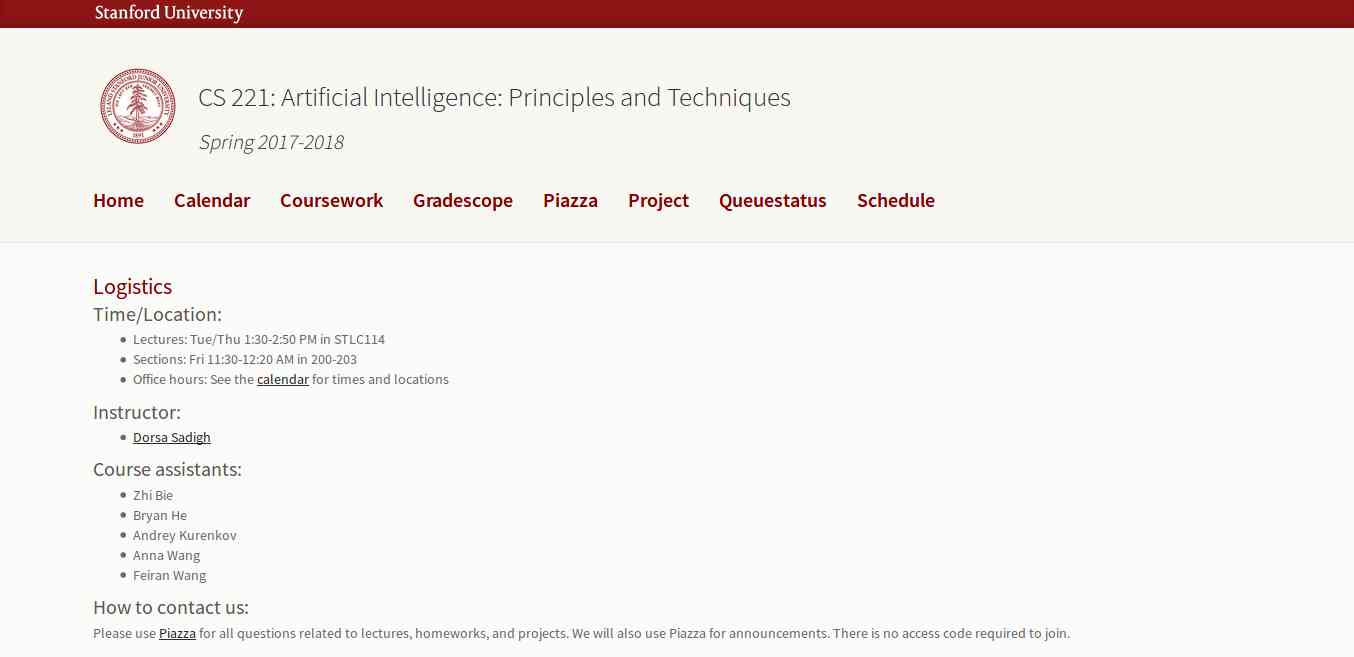
2. Artificial Intelligence: Principles and Techniques

This course is offered by Stanford with great content that includes topics, videos, assignments, projects, and exams. The whole course mainly focuses on the complex real-world problems and try to find similarity between web search, speech recognition, face recognition, machine translation, autonomous driving, and automatic scheduling. Here you will learn the foundational principles of AI and implement some the AI systems. The goal of this course is to help you tackle the real-world situations with the help of AI tools. So, it is the best for the beginner to get started with AI.

3. Learn with GOOGLE AI

Who will dislike the course from Google? absolutely no one. This company is one of the early adopters of AI has a lot to offer to learners. Learn with Google AI is an education platform for people at all experience levels, it is free to access and browse content. The education resources provided by Google is from the machine learning experts of the company. These resources are the collections of lessons, tutorials, and Hands-on exercises that help you start learning, building, and problem-solving.

4. MIT 6.S094: Deep Learning for Self-Driving Cars

This course gives the practical overview of Deep Learning and AI. It is the course for beginners, also for the people who are getting started with Machine Learning. The course also offers a lot of benefits to the experienced and advanced researchers in the field deep learning. This MIT's course takes people into the journey of Deep Learning with the applied theme of building Self-Driving cars. However, the course also offers slides and videos to engage the learners.

5. Fundamentals of Deep Learning for Computer Vision

This course is offered by Nvidia and Nvidia Deep learning Institute. Computer Vision is one of the disciplines of AI that acquire, analyze, process, and understand images. The course is completely free and everyone who is enthusiast about AI can access and learn the course. It is a hands-on course that able to provide basics of deep learning and deployment of neural networks. With this. you will also learn the following:
  • Identify the ingredients required to start a Deep Learning project.
  • Train a deep neural network to correctly classify images it has never seen before.
  • Deploy deep neural networks into applications.
  • Identify techniques for improving the performance of deep learning applications.
  • Assess the types of problems that are candidates for deep learning.
  • Modify neural networks to change their behavior.
Related articles

How To Secure Your Home Against "Internet Of Things" And FUD

TL;DR, most of the security news about IoT is full of FUD. Always put the risks in context - who can exploit this and what can the attacker do with it. Most story only covers the latter.

Introduction

There is rarely a day without news that another "Internet of Things" got hacked. "Smart" safes, "smart" rifles, "smart" cars, "smart" fridges, "smart" TVs, "smart" alarm systems, "smart" meters, "smart" bulbs, NAS devices, routers. These devices are getting hacked every day. Because most of these devices were never designed with security as a goal, and some of them have been never tested by security professionals, it is no surprise that these things are full of vulnerabilities.


Independent security researchers find these vulnerabilities, write a cool blog post or give a presentation about the vulnerability and the exploit, and the media forgets the constraints just for the sake of more clicks. "We are all doomed" we can read in the news, but sometimes the risks are buried deeply in technical jargon. Please note I blame the news sites here, not the researchers.

http://www.slideshare.net/danielmiessler/iot-attack-surfaces-defcon-2015

There are huge differences between the following risks:

  • Attackers can directly communicate with the router (or camera) from the Internet without authentication and exploit the vulnerability. This is the worst-case scenario. For example, an automated ransomware attack against your NAS is pretty bad.
  • Attackers have to position themselves in the same WAN network (e.g. Sprint mobile network in the case of Jeep hacking) to exploit the vulnerability. This is still pretty bad.
  • The vulnerable code can not be triggered directly from the Internet, but tricks like CSRF can be used to exploit it (details later in this post). 
  • The vulnerable code can not be triggered directly from the Internet, and it uses a protocol/port which prevents Cross Protocol Scripting. Attackers have to access the local network before exploiting this vulnerability.
As it is the case with the worst scenario, one can find a lot of devices connected to the internet. You can always find funny stuff at http://explorer.shodanhq.com/#/explore , or use the nmap screenshot script to find your own stuff :)


Network exposure

Most devices are behind an IPv4 NAT device (e.g. home router), thus can not be reached from the Internet side by default. Except when the device configures the firewall via UPNP. Or the device has a persistence cloud connection, and the cloud can send commands to the device. Or the device uses IPv6 tunneling (e.g. Teredo), thus it is reachable from the Internet. But not every vulnerability on your home network is accessible directly from the Internet. As more and more devices and networks will support IPv6, this scenario might change, but I hope most home routers will come with a default deny configuration in their IPv6 firewall module. On the other hand, scanning for IPv6 devices blindly is not feasible due to the large number of IPv6 addresses, but some tricks might work

If attackers can not access the device directly, there is a way to hack it through the user's browser. Just convince the victim user to visit a website, and via CSRF (Cross Site Request Forgery) and brute-forcing the device IP, it is possible to hack some devices (mostly through HTTP - if the exploit can fit into simple GET or POST commands.

If attackers can not attack the device vulnerability through the Internet directly, or via CSRF, but have connected to the same network - the network exposure shrinks significantly. And when attackers are on the same network as you, I bet you have bigger problems than the security of the IoT devices ...

Recommendations for home users

Don't buy **** you don't need

Disconnect from the power cord the IoT devices you don't need to operate 7*24. 

Disable cloud connectivity if it is not necessary. For example, I have a NAS device that can be reached through the "cloud", but I have disabled it by not configuring any default gateway for the device. I prefer connecting to my network via VPN and reach all my stuff through that.

Prevent CSRF attacks. I use two tricks. Don't use the 192.168.0.x - 192.168.10.x network at-home - use an uncommon IP range instead (e.g. 192.168.156.x is better). The second trick is I configured my Adblock plugin in my primary browser to block access to my internal network. And I use another browser whenever I want to access my internal devices. Update: On Firefox you can use NoScript ABE to block access to internal resources.


Check your router configuration:

  • disable UPnP
  • check the firewall settings and disable unnecessary port forwards
  • check for IPv6 settings, and configure the firewall as default deny for incoming IPv6 TCP/UDP.

Change default passwords, especially for services connected to the Internet. Follow password best practices.

Run Nmap to locate new IoT in your home network :) 

Run a WiFi scan to locate new WiFi access points. Let me share a personal experience with you. I moved to a new house and brought my own WiFi router with me. I plugged it in, and forget about WiFi. Months later it turned out I had two other WiFi devices in my house - the cable modem had its own integrated WiFi with default passwords printed on the bottom, and the Set-top-box was the same - default WiFi passwords printed on the bottom. And don't forget to scan for ZigBee, Bluetooth, IrDA, FM, ...

Update your devices - in case you have a lot of free time in your hand.

Don't allow your guests to connect to your home network. Set up a separated AP for them. Imagine your nephew stealing your private photos or videos from your NAS or DNLA server.

With great power, comes great responsibility. The less device you own in your house, the less time you need to maintain those.

Read the manuals of your devices. Be aware of the different interfaces. Configure it in a secure way.

Disable Teredo protocol in case you don't need IPv6.

Stop being amazed by junk hacking.

Update: Disable WebRTC: https://www.browserleaks.com/webrtc , in Chrome you can use this extension: https://chrome.google.com/webstore/detail/webrtc-network-limiter/npeicpdbkakmehahjeeohfdhnlpdklia

Update: Prevent against DNS rebind attacks via configuring a DNS server which can block internal IP addresses. OpenDNS can block internal IP, but this is not a default option, you have to configure it.

Recommendations for vendors

For vendors, I recommend at least the followings:

  • Implement security during Software Development LifeCycle
  • Continuous security testing and bug bounties
  • Seamless auto-update
  • Opt-in cloud connectivity

Recommendations for journalists

Stop FUD. Pretty please.

The questions to ask before losing your head

  • who can exploit the vulnerability?
  • what prerequisites do we have about the attack to successfully exploit the vulnerability? Is the attacker already in your home network? If yes, you have probably bigger problems.
  • what can the attacker do when the exploit is successful?

And last but not least, don't forget that in the case of IoT devices, sometimes users are the product, not the customer. IoT is about collecting data for marketing purposes.


Related articles